
SWF Research Officer Eilidh Galbraith attended the Faith Lives of Women and Girls research symposium at the University of Chester in June 2026, along with Emma Pavey. Here, Eilidh reflects on the day.
This year’s Faith Lives of Women and Girl’s conference gathered researchers and practitioners around the varied and deeply personal ways that women’s faith, agency and embodiment are lived out. Although there was no set theme to the presentations, there was a seemingly incidental but very discernible common thread running through the day – much of the conversation centred on women in midlife. Contesting paradigms which situate midlife as a stage to be dreaded or endured, the presentations instead revealed experiences of women in midlife as new ways of being and knowing.
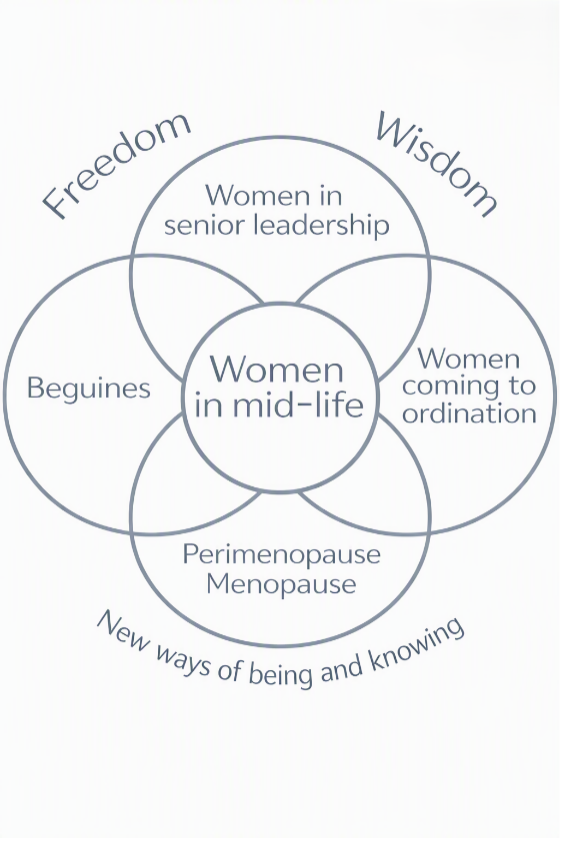
Noelia Molina opened with an exploration of the Beguine movement – medieval female-led communities which functioned as an alternative to marriage or convent life – considering how and why these communities have survived, or indeed have been revived, across Europe. She found that today, many beguines are formed of women in midlife, expressing a desire for ‘freedom’ and ‘a way to be in the world, but not of the world.’
Exploring themes of vocation, Noreen O’Neil, Abigail Cawte and Ruth Hartley examined the ways in which women, particularly older women in senior and church leadership roles, navigate the tensions between their own sense of identity and gendered perceptions which devalue ‘feminine’ ways of leading. Hartley’s study of older women in the Church revealed strategies of resistance, which she defined as ‘defiance, desire, and delight’; reclaiming labels like ‘gobby woman’ as expressions of agency.
Liz Shercliffe, launching her latest volume ‘May She Speak in the Name of the Father: Patriarchy, Preaching and the Gospel’, made explicit that these challenges are not only attitudinal but structural, particularly in contexts of formation and ministerial education. Her new volume not only names these institutional biases but offers practical strategies for building more inclusive pedagogical practices.
The perimenopause panel, chaired by SWF Associate Director Emma Pavey, and drawing together Professor Hannah Bacon, Rev’d Dr Sarah Brush and Dr Faith Van Horne around Emma’s own recent research, turned these questions of voice and agency to the body, and explored the ways perimenopause and menopause is constructed and concealed, socially and theologically. While popular discourse typically frames menopause in terms of ‘deficiency’ and ‘disorder’, the panel offered a different vocabulary: framing menopausal bodies as queer, liminal, even leaky. Bodies that, like fat, disabled, and queer bodies, transgress their expected boundaries, refusing the straight, linear logic of before-and-after, ‘rupture and repair’ that theologies of restoration and resurrection often perpetuate. Menopause understood in this way is not then considered a ‘decline’, but rather can be a generative and valuable form of embodied knowledge. Here Emma quoted Rebecca Solnit: “The stars we are given. The constellations we make.”(1)
Turning to poetry as an expression of embodied knowledge, the Ven Dr Rachel Mann explored its power as ‘feminist word in action’. Drawing on the work of Christina Rossetti and Rebecca Goss alongside her own, Mann considered the female body as a complex site of both creation and resistance; a refusal to be, in her words, ‘code for another’s sins’.
Across these conversations it was clear that women’s experiences and knowledge, particularly those of midlife, continue to be discredited and devalued – highlighting an area that theology and academia have yet to take seriously. But they also revealed the ways in which women, across all life stages, continue to reclaim their identity and agency, and the importance of spaces like these for those voices to be heard.
(1) Solnit, R. 2008. Storming the Gates of Paradise: Landscapes for Politics, p.165, University of California Press.