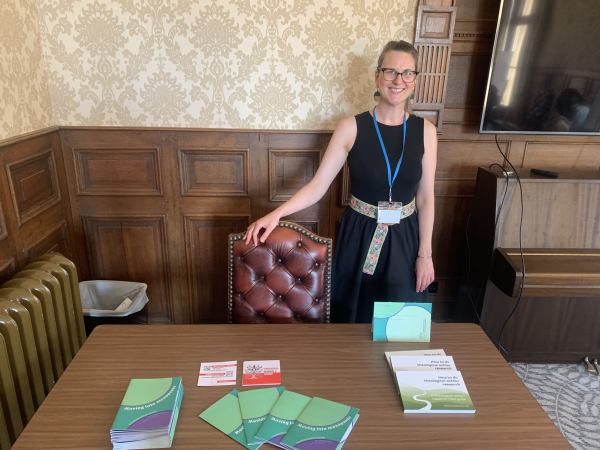
SWF Research Officer Stefanie Conradt attended the conference of the British and Irish Association for Practical Theology (BIAPT) in July 2026. Here she reflects on the presentations.
This year’s BIAPT conference (7-9 July 2026) was dedicated to the theme Power and the Common Good. Delegates had opportunities to halt, engage with insightful reflections and discern our respective contexts, positionalities and ways of theologising across several workshops, reflection groups, papers and the contributions of the keynote speakers: Dr Beth Philipps, Dr Eric Stoddart and Rev Dr Raj Patta.
Drawing on Catholic social thought, Philipps proposed that the common good emerges when love and justice is cultivated alongside activism and receptivity (i.e. the act of attention). Stoddart drew our attention to issues of power through the surveillance and unjust targeting of individuals and minorities groups. Approaching the topic from the surveillance of the cross (a God who knows and suffered under surveillance), Stoddart proposed a subverting of this power by i) tapping into the power of prepositions (surveillance for and with, rather than of and from), and ii) drawing on the power of unmasking, which might involve as little as asking questions such as: to what extent have we been conditioned to accept violence and oppression, and when, and how? Patta concluded the conference by offering thoughts and insights on how to re-imagine public Christian witness for the common good. Asking whose understanding of God has been normalised, he vocalised the need to de-colonise our way of talking about God. An impactful moment was his solemn statement: “My dreams cry out to freedom”.
In light of these keynote speakers, the Christian witness and distinct Methodist call ‘to do all the good we can … for all the people we can’, becomes distinct in that we need to attend to and unmask subversive systems of power so that “no one searching to belong to the Body of Christ should be denied becoming part of the Body of Christ” (Raj Patta).