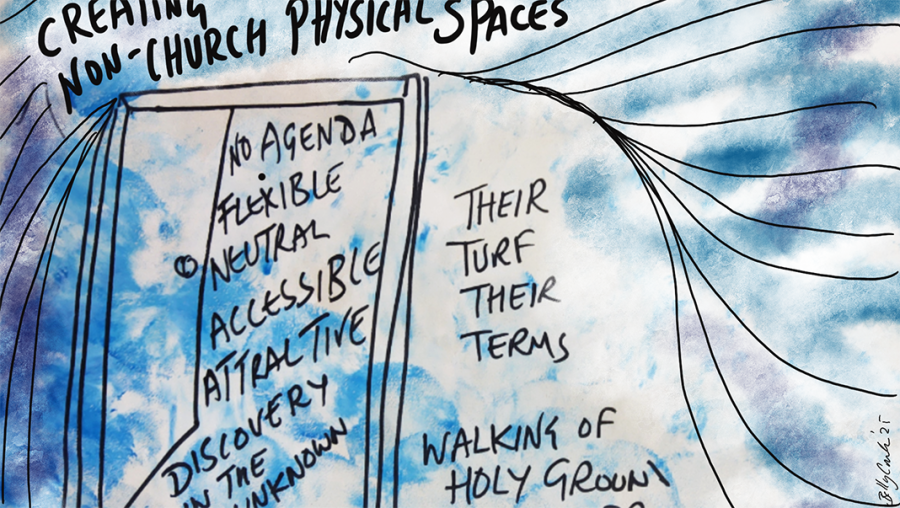
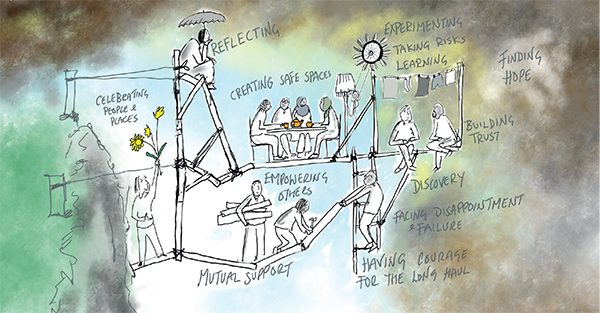
We’re pleased to release the project report into a project SWF supported in collaboration with the St Peter’s Saltley Trust entitled Edgy Faith and Edgy Learning, written by Dr James Butler, Prof Clare Watkins and Dr Ian Jones. Using theological action research methodology, the team worked with seven groups who identified themselves as ‘edgy’. Visual illustrations in the report were produced by Bill Crooks with report design by Emma Pavey.
Read more below from the research team:
The ‘edgy’ places
This University of Roehampton research project set out to explore faith, and the way faith grows, develops, changes and is passed on, in “edgy” places. We worked in partnership with 7 different sites which in various ways were “edgy” asking them to help us explore faith within their context. Some were “edgy” in relation to church, like chaplaincy and pioneering ministry; others were “edgy” socio-economically, facing challenges of unemployment and cost-of-living; and others were “edgy” in other ways concerning race, ethnicity, and working with prison leavers. What we found were the joys and challenges of faith in those places of edginess. We reflected together on a wide range of issues that arose from the work within the sites: the challenges of faith being passed on; the ways in which faith is discerned in these different contexts; the effect of pressures from funders and sponsoring denominations on work at the edges; the importance of agency and being known for people living at the edges; the glimpses of what edgy spirituality looks like; the things more mainstream churches can learn from such edgy experiences; and questions of how such work might – and might not – be replicated in other places.
Using Theological Action Research:
As a theological action research project, the work was always focused on participation, collaboration, the renewal of practice, and allowing those voices of practices to inform the wider theological account of “edgy” faith and “edge” learning. Just as we worked with the sites in a collaborative partnership, we developed similar relationship with both our funders, The St Peter’s Saltley Trust and the Susanna Wesley Foundation. They worked with us in the project in a variety of ways, and we are grateful, not just for their funding, but also for their participation, their wisdom, and their energy and effort in embracing and engaging with faith in edgy places.

Impact:
It was a privilege to work with all the sites in the project who invested their time and energy in the project, and learnt with us as we reflected together. We had an excellent and insightful day gathering all the sites together at the end of the project as we all shared what we had learned and what had changed as a result of the project in each of the sites. We know that much of the learning from the project will be best passed on in conversations within the sites, around the sites and with those engaging in similarly “edgy” places. This caused us to approach the report in a slightly different way. Rather than simply trying to sum up our learning from across the project, our aim in this report has been to give a glimpse into the insights and learning emerging in each site through a series of letters written to the sites.
We share this report, not as a series of recommendations, but rather as an invitation to explore and learn from edginess – the edginess we encountered in the project, and the edginess around you in the context you are in. We hope that the project might whet the appetite of those who read it to embrace the patience, the attentiveness and the curiosity of the sites we worked with and find the riches which comes from faith in edgy places.
Prof Clare Watkins, Dr James Butler and Dr Ian Jones (St Peter’s Saltley Trust).
Download and save the pdf of the report here.